
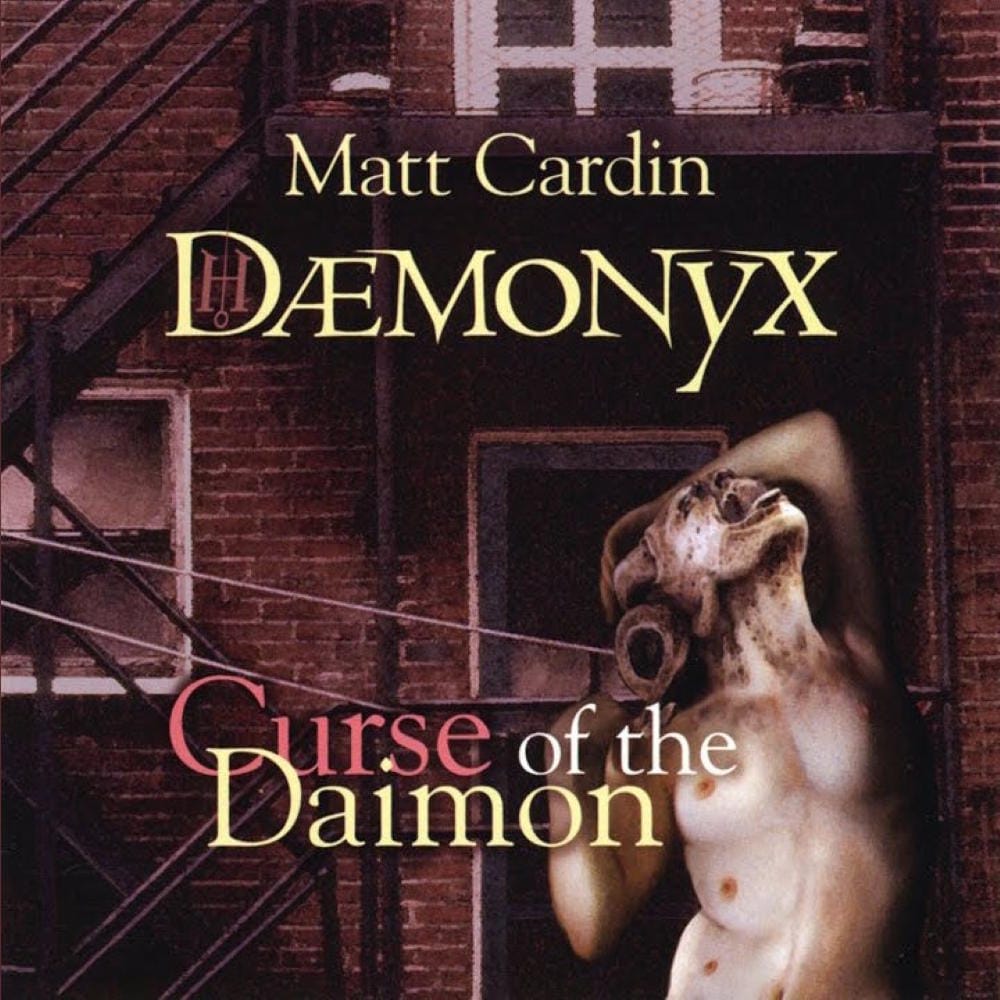
NOTE: If you’d like to listen before reading, you can download the complete album and liner notes here. Access is free for subscribers.
When I announced the consolidation of my writing at MattCardin.com, I mentioned that I would also be making an album of my original music available to subscribers. This is a project that I created some years ago under the name “Daemonyx,” and if you’ve been following my career for a while, you probably remember it. For most of my life, all the way back to my childhood, writing and music have both been ways for me to hear and follow an inner creative impulse and find out how it wants to emerge.
The album is Curse of the Daimon, which I produced from 2005 to 2008. Some of my readers already own it because Mythos Books shipped it as a compact disc accompanying copies of my second book, Dark Awakenings, that were purchased directly from the publisher (instead of from Amazon etc.). This decision to pair the book with the album was thematically appropriate because the music I composed crosses paths at multiple points with my work as an author of horror fiction and nonfiction. It also directly intersects with my writing about creativity as a relationship with one’s inner creative spirit in A Course in Demonic Creativity and Writing at the Wellspring. And just like those books, stories, and essays all came out of my attempts to listen and engage productively with promptings from inner space, the album had its origin in the music I kept hearing in my head.
An inner soundtrack
For many years my instrument was a Yamaha Motif ES8 digital piano and music workstation/sequencer, which I acquired in 2005 to replace the 1930s Chickering grand piano that I grew up with. I sold the Chickering to buy the Yamaha because I was gripped at the time — possessed, you might say — by an inner musical upwelling that wanted to be realized and recorded.
The album began as a set of musical motifs that began playing in my head shortly after I went to work selling musical instruments in 2004 for a business in Springfield, Missouri, that sold Yamaha grands and digitals. Whenever I wasn’t working with customers or otherwise minding the store, I would play the various instruments in the showroom. Before long, I began to hear a constant inner soundtrack of new music as I went about my days and nights.
This was not a new phenomenon. It had happened to me before. Beginning at age 8, I had nine years of classical piano lessons, and I took to the instrument avidly. Something inside me resonated powerfully with the piano, with the mental, emotional, tactile, and musical experience of relating to that instrument and learning how to feel and make music with it. Then, in my teens during the 1980s, I acquired a Kawai analog synthesizer and a little four-track cassette recorder, and with these I devoted many hours to making electronic musical compositions. This continued throughout college, where I majored in radio and television production and composed the scores for my classroom video projects (and also for a feature-length parody of epic fantasy movies that my roommates and I made as an extracurricular project during my senior year, but that’s another story, and one I may or may not someday tell in full).
By the early 2000s, when I went to work in the piano store, the sophistication of digital musical instruments had increased to the point where, for the first time, I could produce fully realized versions of the music that had always played in my head, surpassing the limitations I had always felt with my previous gear. And as it turned out, something within me had been biding its time until a situation would manifest that would put me in touch with those very instruments, and that would put my hands on pianos and keyboards every day.
In 2004, almost from my first day of work at the music store, I found that the environment stoked the coals of my inner musical engine. The music began playing vividly in my mind again, and soon I began to snatch moments throughout each workday, and then to stay for hours after closing, to experiment with, figure out, compose, arrange, and record those songs, which I heard quite vividly in my mind’s ear. Often one of them would start with only a few phrases, or sometimes only a brief, repetitive, looping tune, beat, and/or pattern. If I let this establish and clarify itself for a day or two, then when I finally sat down at a piano to find out what it looked and felt like on the actual keyboard — what key it was in, what notes were involved, and so on — the music would move on and let me hear the next portion, and then the next, until eventually it resolved into a finished piece.
This all became so pressing as an inner creative upwelling that I ended up using my employee wholesale access to buy the Motif plus a Yamaha AW16G audio workstation, after which I ended up finishing the album at home.
“The whole Daemonyx album just flooded out of me, from the same inner place that is the source of my horror writing and my religious and spiritual motivations.”
Speaking of home, my music had a room of its own in one of the two bedrooms in the basement of our house in the Southwest Missouri Ozarks. It was there that I kept the keyboard/piano and the separate digital workstation. This was part of a total environment that, though I didn’t really think about it at the time, was fairly fertile, as the basement was also where I kept my books, many hundreds of them, and the computer on which I wrote my stories and essays. These various elements of my private creative life, which I kept almost wholly divorced from my daytime career as a school teacher and church musician, were emotionally powered by years’ worth of accumulated thematic interests and obsessions — horror, religion, consciousness, creativity, a fascination with apocalyptic cultural collapse, and the question of how and why these were all connected in my unchosen fascinations — that pressed for some form of expression.
Is there someone inside you?
While I was recording, I returned frequently to the question of what I should name my musical project. Right from the start I knew the name would have to be something centered around the idea of the daimonic or daemonic, since that idea had been central not only to my musical endeavors but also to my writing and other creative work for many years.
To review, for those who are unfamiliar with it: The idea of the daimonic is loosely related to the idea of the muse. What particularly drew me was the idea of a personal daimon, a guiding spirit whose influence could be felt in the passions, tendencies, and sense of calling that seem to arrive with us rather than being chosen by us. We have all noticed that everyone seems to be born with certain predilections and personality traits already firmly in place. It seems that each of us possesses, or rather is possessed by, innate passions and interests, attractions and aversions, traits and tendencies. It also often seems that we are each led to encounter and experience certain sorts of life experiences and circumstances that are beyond our power to prevent.
One doesn’t have to believe in this literally in order to feel its pull or sense its marvelous explanatory power. It’s possible to view it as a kind of perfect metaphor. It’s also possible to refuse to assign it an ontological status at all. Various books proved important to me in establishing, unfolding, and enriching this understanding. Perhaps chief among these was James Hillman’s The Soul’s Code: In Search of Character and Calling, which explores the daimon as a kind of life calling, a source of personal orientation. In a distinctly separate vein, and in a distinctly separate way, Patrick Harpur’s Daimonic Reality: A Guide to the Otherworld played an important role.
My identification with the piano had been accompanied from early in my life by an equally strong identification with books, reading, and writing. Later, when I was in high school and college, my passion for playing music became joined by an additional passion to compose it. In daimonic terms, these things felt like parts of my calling. And not only the activities themselves, but the types of subject matter that I was naturally drawn to exploring.
“There was always a deep exhilaration as well, and [a] mingling of this with terror and inner daimonic domination.”
Without my being able to help it, there was always something dark, dreary, horrific, melancholic, and/or mournful lurking beneath the surface and often breaking through into plain sight in all the creative works I pursued. I was also ineluctably drawn to explore philosophical and spiritual ideas like the ones I’m discussing right now. Long before I encountered the concept of the daimonic, I had already spent a lot of time musing over my own sense of being driven by a motivating source I couldn’t understand, which led me to feel passionate about things I couldn’t control or choose. The daimon theory gave me a name and background by which to contemplate these things more effectively.
So the name Dæmonyx, which was specifically suggested to me by Jason Van Hollander, expresses both the dæmonic/daimonic source of my musical motivation and the darkness (the onyx, as it were) that characterizes the music itself. By framing my musical endeavors in dæmonic terms, I also freed myself to pursue whatever tangents I felt like pursuing.
My music, the songs that began to come out when I was put in touch with instruments capable of realizing what I was hearing internally, was less easy to classify than my writing. Some of it was definitely New Agey. Some was all-out heavy metal and rock. Some was classical or classical-esque. Some was electronica. Taken together, it mostly sounded like a dark movie soundtrack composed in various musical forms and genres.
Sometimes the connection between reading and composing was quite direct. One of the songs I created represented a detailed outworking of a theme and beat that had begun to play insistently in my head almost immediately after I began reading Thomas Ligotti’s little book, Death Poems, back in 2004. The book ends with a section of blank pages titled “My Own Death Poems,” where the reader is presumably intended to record his or her own thoughts about the meaning and inevitability of his and everybody else’s ultimate demise (which is the theme of the book). This piece emerged as my response, which is why I gave it the title “My Own Death Poems.”
I felt especially fortunate that the finished album drew praise from the likes of Ramsey Campbell and Thomas Ligotti, writers whose work meant so much to me. In Ligotti’s case, there was an added significance, in that his work had directly inspired two of the songs, and now he was responding to the music in turn.
A shattering and beautiful sensation
The title of the album itself, Curse of the Daimon, gets at the fact that I really did feel at times as if the so-called “artistic temperament” that accompanied and characterized all of this was a curse. How much simpler and nicer it would have been to return to a former period in my life when I could read a book or watch a movie or listen to a song without feeling that if I myself didn’t currently have a creative project in progress, then I was failing myself in some deep, frightening way.
Yes, when I successfully finished composing and recording a song, or when I completed the final revision of a story or essay, I did feel an enormous rush of pleasure. Occasionally I even felt pleasure during the act of creation itself. But it was accompanied by a distinct internal pressure that felt rather ominous, so that in the end it was hard to avoid the conclusion that the rush I felt upon completion wasn’t so much due to having achieved success as having avoided failure. For ultimately the failure in question wouldn’t just be related to the specific song or story in question, but would more substantially be a deep failure to live up to something that always drove me onward and set an often impossible bar to achieve.
There was always a deep exhilaration as well, and the mingling of this with terror and inner daimonic domination found its most explicit expression in a piece that I titled “Daimonica.” Its “lyrics” take the form of a montage of audio and dialogue clips from movies that have been important to me. I came to realize that I had been mentally gathering these across time. In the track, those remembered voices and moments came together with the music to express the very experience that was driving me to compose it.
“The music would move on and let me hear the next portion, and then the next, until eventually it resolved into a finished piece.”
“Is there someone inside you?” the voices ask. “I am the puppet master,” another declares. But alongside these intimations of possession and control is an assertion of something else, a kind of extraordinary clarity: “It is not a breakdown / I’ve never felt more orderly in my life.” The language of “some great unseen living force” leads into “a shattering and beautiful sensation” and the feeling of being “on the verge of some great ultimate truth.” In other words, the terror and the exhilaration somehow belong together. The audio montage in “Daimonica” sums up the album’s guiding theme and metaphor.
When I first started noodling around on a Yamaha CVP-309 digital piano during one long afternoon in the music store, and when I somehow came up with the basic synth motif that forms the backbone of this song, I was quite consciously influenced by some of Goblin’s music, especially the main theme from the movie Tenebrae, which was playing in the back of my head at the time. The same theme served as my point of departure for “Daimonica’s” tech-sounding drum track. So the films entered the music in more than one way, not only through the voices I had been gathering, but through the soundtrack music already playing in my mind.
Elsewhere on the album — appearing in fact as the first words spoken among the music, in the opening track, titled “The Gates of Deep Darkness” (a phrase drawn from the biblical Book of Job) — a line from Mary Shelley’s Frankenstein expresses the same daimonic message with no ambiguity whatsoever: “There is something at work in my soul which I do not understand.”
There was also a cinematic reference in the title of the album itself, which harks back to one of the finest horror movies ever made, 1957’s Night of the Demon, released in the U.S. as Curse of the Demon.
At the same wellspring
Those years spent producing the album, from 2005 to 2008, represent far and away the most intense period of musical creativity that I have ever experienced. I have continued to play the piano regularly since then, sometimes in connection with churches, sometimes devoting many hours per week to playing privately. It’s an enduring part of my life.
In the years after the album, the very act of playing the piano became more and more central to my enjoyment of everyday life. On most evenings I spent at least a little time playing one or several of Bach’s two-part inventions, a little Beethoven, maybe some modern piano stuff along the lines of the Windham Hill albums or Ludovico Einaudi’s meditative piano compositions, and maybe noodling around with improvisational stuff. It became a kind of discipline, or maybe a pressing need, or actually both, that helped to get me in the right inner state for writing, the state where I could actually hear and feel the promptings of my daemon muse and successfully get them into some tangible form.
Much of that private playing has been a kind of meditation. Among the pieces I have returned to repeatedly are Satie’s “Gymnopédie No. 1”; Einaudi’s “Monday” and “Discovery at Night”; Yann Tiersen’s “Comptine d'un Autre été: L'Après-Midi,” from his soundtrack for the French film Amélie; Chip Davis/Mannheim Steamroller’s Interlude I and a piano-only arrangement of “Velvet Tear” from the Fresh Aire albums; the main theme from Claudio Gizzi’s score for Blood for Dracula, which I arranged for piano myself from the orchestral version; and deeply pensive arrangements of the church hymns “It Is Well” and “Be Still My Soul.”
I also created some tracks separate from what went into the album, sometime in the wake of that several-year explosion, when I composed opening and closing music for an audio reading of Conrad Aiken’s classic short story “Silent Snow, Secret Snow.” The story is about a boy who becomes progressively more lost in the blissful isolation of an inner world or otherworld of spectral snowfall, until his disappearance is complete. This is still available on YouTube, where, as you can hear for yourself, my dear friend Jon Padgett’s performance as the reader is simply exquisite. I composed and performed the music specifically for the purpose of accompanying his reading of this story. It appears at the beginning and the end (with the end music representing a snippet of a slightly longer piece that I may share with you later).
Even though I haven’t composed any new music for many years now (except for a coupl of piano pieces that I shared in the past few years at my former Substack newsletter), music and the writing have remained intertwined for me. The whole Daemonyx album just flooded out of me, from the same inner place that is the source of my horror writing and my religious and spiritual motivations. It’s all connected at the root.
That connection is why the album belongs here at my website, alongside my books and essays. For those who know my writing, I hope the music will offer another way into the same core themes and interests. And for those who remember Daemonyx, I’m glad to be giving it a home here again.
I'm making the complete album available as a free MP3 download to subscribers at MattCardin.com. You'll find it at the Daemonyx page. All you need is a free subscription. The page also features a downloadable PDF serving as a complete set of liner notes, essentially a digital version of a CD insert, that brings together track notes and information on musical influences, film sources, the album’s production gear and history, and more.
I also have a limited number of physical compact discs available for purchase, complete with cover artwork by World Fantasy Award-winning artist Jason Van Hollander, who, as I said, also suggested the name Daemonyx.
Daemonyx: The story behind my music
My other creative life.